
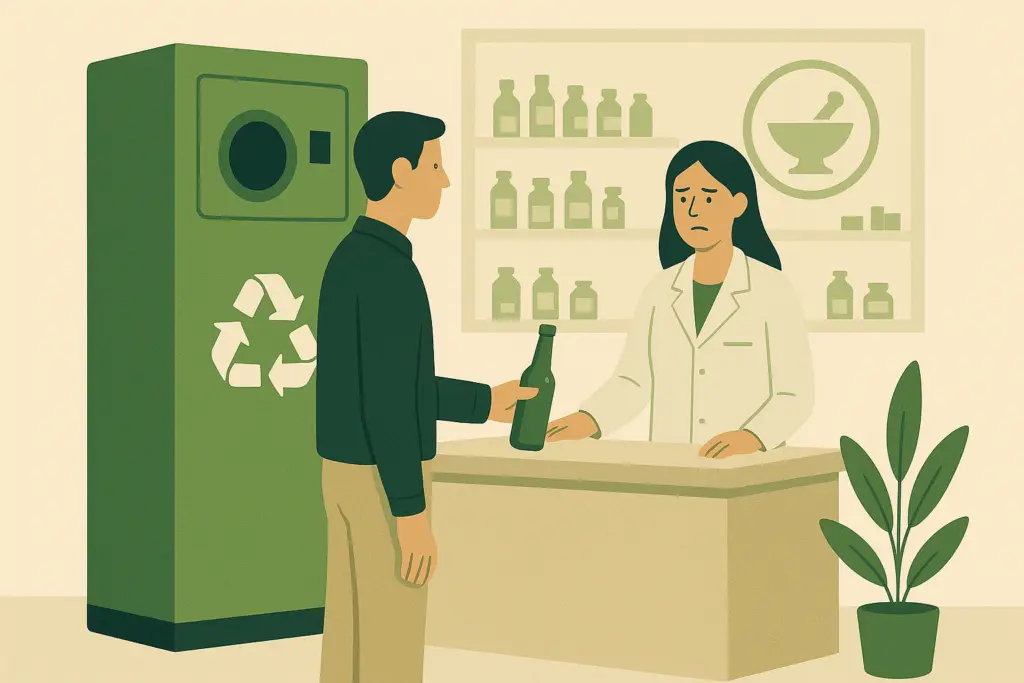
The Ministry of Climate and Environment has confirmed that pharmacies may be included in the deposit return scheme if they meet the statutory conditions. At the same time, numerous reports on this issue have appeared in public, some of them inaccurate, such as repeated media claims that pharmacies would have to accept empty beer bottles. It is therefore worth explaining the circumstances in which pharmacies may be required to participate.
Which pharmacies will have to join the deposit return scheme?
Pharmacies will have to join if they decide to sell beverages in packaging covered by the scheme, namely:
- plastic (PET) bottles of up to 3 litres;
- metal cans of up to 1 litre; or
- reusable glass bottles of up to 1.5 litres.
The obligation will therefore apply to pharmacies selling, among other things, water, isotonic drinks and dietary supplements in plastic bottles or cans. Medicines are excluded, however, even where sold in packaging that would generally fall within the scheme.
What determines a pharmacy’s obligations under the scheme?
The scope of a pharmacy’s obligations depends on two factors:
- its product range; and
- its sales area, specifically whether it is below or above 200 m².
Even pharmacies with a sales area of up to 200 m² must join if they offer beverages in packaging covered by the scheme. Their obligations will, however, be limited.
How is a pharmacy’s sales area calculated?
The sales area means the publicly accessible part where retail sales take place. Ancillary areas such as storage rooms, offices and circulation space are excluded.
What obligations will pharmacies have?
Small pharmacies with a sales area of up to 200 m² must:
- charge deposits;
- enter into an agreement with at least one scheme operator that approaches them;
- inform customers about the scheme, including the possibility of returning packaging and recovering the deposit charged;
- keep scheme records.
Consequently, small pharmacies generally will not have to accept empty packaging from customers, except reusable glass bottles, which they are unlikely to sell in any event.
Large pharmacies with a sales area exceeding 200 m², in practice mainly chain pharmacies, must:
- charge and refund deposits;
- accept packaging from customers;
- enter into an agreement with every scheme operator that approaches the outlet;
- inform customers about the scheme, including returning packaging and recovering deposits;
- keep scheme records.
Consequently, large pharmacies will have to accept empty packaging from customers.
Must a pharmacy accept packaging from drinks it does not sell?
Although neither the legislation nor the ministry’s interpretation states this expressly, pharmacies should be regarded as obliged to collect only the types of beverage packaging they sell. For example, if a pharmacy sells no drinks in metal cans, it should not be required to accept empty cans. However, if it offers water in plastic bottles from only one producer, it must collect all plastic bottles covered by the scheme, regardless of the producer.
Does a pharmacy need additional storage space for packaging?
Pharmacies may also collect packaging using reverse vending machines located outside their premises. This reduces the problem of lacking back-of-house space for packaging returned by customers.
What should a pharmacy look for when entering into an agreement with a scheme operator?
Every pharmacy selling beverages in packaging covered by the scheme must enter into an agreement with a scheme operator, known as a “representative entity”. Small pharmacies must contract with at least one operator; large pharmacies with every operator that approaches them.
When contracting, a pharmacy should pay particular attention to:
- how deposits are settled with the operator;
- how the operator secures deposit settlements;
- how the operator finances the pharmacy’s packaging collection;
- how packaging is collected from the pharmacy or reverse vending machine.
What penalties can a pharmacy face for failing to implement the scheme?
Pharmacies’ obligations are backed by numerous administrative fines, including:
- failing to charge or refund deposits: PLN 10,000–500,000;
- failing to accept packaging: PLN 10,000–500,000;
- failing to inform customers about the scheme: PLN 10,000–50,000;
- failing to keep scheme records: PLN 10,000–50,000.
Find out more about the deposit return scheme.