

Growing passenger numbers drive rapid aviation development and new technologies and services. More contractual disputes inevitably follow. Effective resolution requires both efficiency and decisions demonstrating understanding of this complex industry.
The latest International Air Transport Association (IATA) report confirms continuing demand growth. November 2024 data show increases in passenger and cargo demand and capacity.
Global cargo demand rose 8.2% CTK[1] against November 2023, the sixteenth consecutive monthly increase. Capacity rose 4.6%. Europe, representing 21.4% of global cargo traffic, recorded 5.6% CTK growth[2].
Passenger demand rose 8.1% RPK[3], with 5.7% ASK growth[4]. Load factor reached a November record of 83.4%, up 1.9 percentage points. International demand increased 11.6%, capacity 8.6%, and load factor reached 83.4%, up 2.3 points, mainly driven by Europe and Asia-Pacific.
Rapid sector growth increases both the need for expertise and disputes. Who besides national courts can resolve them effectively, with the necessary industry knowledge?
The Hague Court of Arbitration for Aviation (HCAA) addresses this need. On 10 January 2024 it held another conference bringing aviation and legal professionals together. Topics included arbitration’s advantages, mediation and dispute management. Particularly interesting presentations were Les Schiefelbein’s “Understanding the Language of Aviation in Aviation Disputes”, as HCAA advisory board member and CEO and co-founder of Schiefelbein Global Dispute Resolution, and Johannes P. Wilheim’s “Weathering Energy Transition Disputes in the Aviation Sector”, as advisory board member and Jones Day partner.
Industry performance and the recent conference provide an opportunity to introduce HCAA and selected procedural principles.
HCAA proceedings
Established in 2022 as a non-profit foundation, HCAA provides independent aviation arbitration and mediation. Its board, advisory board and other bodies do not interfere in cases. It is not governmental. Procedures are administered by the Netherlands Arbitration Institute[5].
Proceedings take place privately before experts. Direct and indirect participants must maintain confidentiality unless law or the arbitration agreement requires disclosure[6]. Equal treatment means each party can present and explain its position and comment on the other’s submissions, documents and information[7]. Parties influence procedure: at any stage, on request or its own initiative, the tribunal may convene a meeting to discuss progress or identify further factual and legal issues[8]. Parties choose the language; otherwise the tribunal does[9].
Evidence
Flexibility is important. The tribunal determines admissibility, burden and assessment only absent contrary party agreement. After consultation, it may appoint the chair to hear witnesses or experts or conduct site inspections unless otherwise agreed[10].
Witness and expert hearings are addressed at the case management conference, alongside costs, electronic communication formats and equipment, document requests and further evidence. The tribunal may permit or order hearings on request or of its own motion[11].
It also determines evidential form. Written witness statements and expert reports may accompany the claim, defence, defence to counterclaim and other authorised submissions. Experts may attend for clarification[12]. Parties must give names in good time. Witnesses may be required to swear or affirm truthfulness, and the tribunal decides whether and how to record hearings[13].
Amending and withdrawing claims
Claims or grounds may be amended within their previously stated value, or increased, until the final hearing begins or, without a hearing, the final permitted submission. Later changes require exceptional tribunal permission. Reductions are unrestricted. The opponent may object where defence is hindered or unjustified delay caused. After hearing parties, the tribunal decides promptly. Even an absent party must have an opportunity to comment[14].
The claimant may withdraw before a defence or counterclaim, or where no pleadings or hearing have occurred. Later withdrawal requires defendant consent, subject to administrative costs and deposits. Failure to pay a deposit by the deadline after a reminder is deemed withdrawal of the claim or counterclaim[15].
Arbitration costs
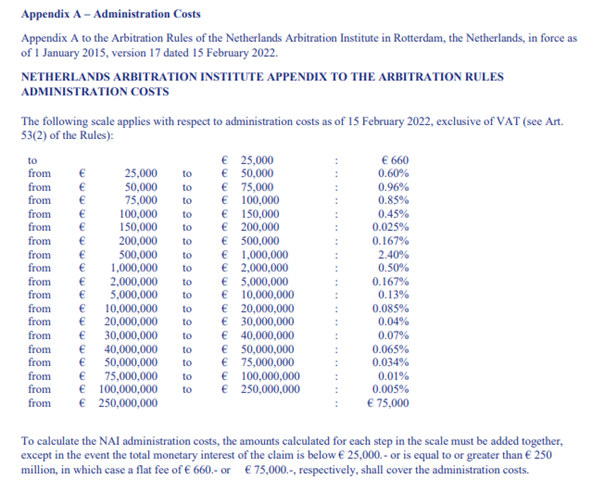
Annex A to the Netherlands Arbitration Institute rules effective from 1 January 2015 sets costs[16]. Amounts exclude VAT:
Source: https://www.haguecaa.org/ASSETS/Documents/ArbitrationCostsHCAA.pdf
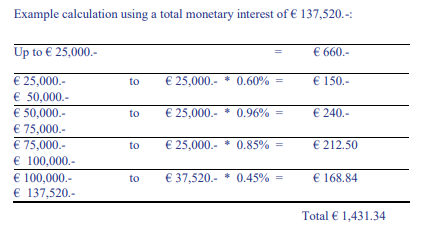
Fixed fees apply below EUR 25,000 (EUR 660) and above EUR 250 million (EUR 75,000). Calculation differs from the familiar Polish proportional court fee. One does not apply a single percentage for the band containing the claim value. Instead, successive bands are accumulated from the EUR 25,000 starting point, adding the remaining portion to reach the total. HCAA illustrates a EUR 137,520 dispute:
Source: https://www.haguecaa.org/ASSETS/Documents/ArbitrationCostsHCAA.pdf
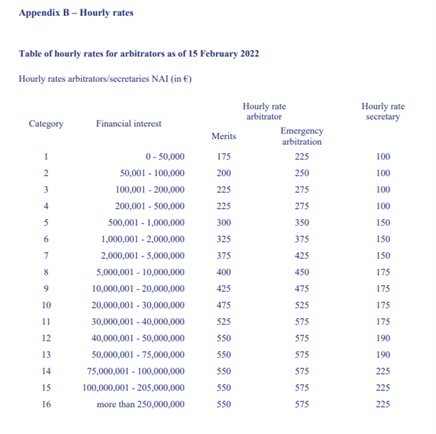
Annex B sets hourly remuneration for arbitrators and secretaries:
Source: https://www.haguecaa.org/ASSETS/Documents/ArbitrationCostsHCAA.pdf
Rapid passenger and cargo growth increases demand for professional dispute resolution, making HCAA valuable. Transparent, considered procedures support quick, confidential and fair outcomes and should encourage its popularity. Benefits resemble arbitration elsewhere: speed compared with courts, greater confidentiality, industry expertise and adaptable procedures within the rules. International arbitration also resolves cross-border disputes without requiring parties to learn and apply one side’s national law.
[1] CTK (cargo tonne-kilometres): actual cargo traffic, weight multiplied by distance. IATA: https://www.iata.org/en/publications/newsletters/iata-knowledge-hub/understanding-air-traffic-metrics/.
[2] https://www.iata.org/en/pressroom/2025-releases/2025-01-09-01/
[3] RPK (revenue passenger-kilometres): paying scheduled passengers multiplied by distance travelled.
[4] ASK/ASM (available seat-kilometres/miles): passenger capacity, available scheduled seats multiplied by distance. https://airlinegeeks.com/2015/12/28/airline-metrics-available-seat-kilometers/#.
[5] https://haguecaa.org/organization
[6] HCAA Arbitration Rules, Article 6(1).
[7] Article 22(2).
[8] Article 22(4).
[9] Article 5(1).
[10] Article 27.
[11] Article 27 read with Article 23(2). Requests should be reasonable and suited to the case, dispute and applicable law.
[12] Article 29(2) read with Article 24.
[13] Article 29(4)–(6) read with Article 24. Where the designated chair conducts examination, a record is always made.
[14] Article 32.
[15] Article 33 read with Articles 52(5)–(6) and 55(6).
[16] Version 17 of 15 February 2022.