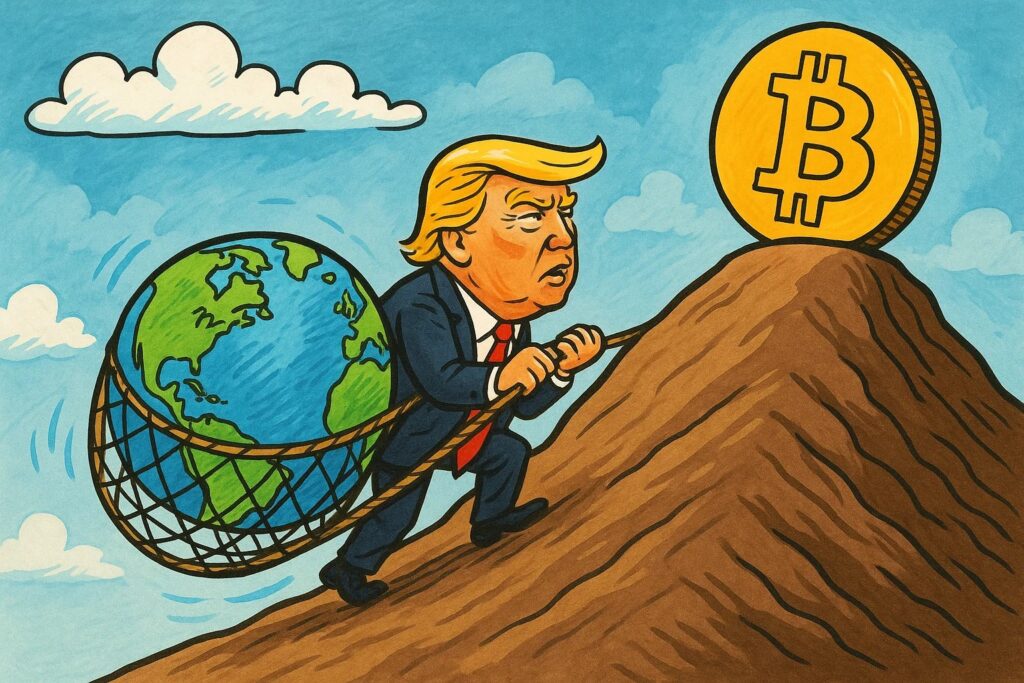


We often come across Bitcoin on our path, wonder what it is, and someone usually explains to us that it’s a cryptocurrency, magical internet money, or a token for speculation on which you can make a fortune. Or lose a fortune. We think, oh interesting, or, this must be a scam, and we go on our way. Sometimes we even consider buying it, but ultimately it seems like too much of a hassle. And you have to spend “real money” to get this thing that you don’t know what it is and keep it in some place that you don’t know where it is. Maybe another time, we think. Several years later, Bitcoin resurfaces. Oh, look, it still exists, we think. Oh dear, it’s several times more expensive, I could have bought it, I would have made a fortune.
I have heard this story many times in books, articles, and podcasts. I took notice of it because my story is similar. Bits and pieces of information about Bitcoin had reached me earlier, but it wasn’t until 2014 that I became interested enough to write an article. I gathered the available information and converted it into a column. I thought I had figured it out. I thought maybe I would even buy some Bitcoin. Just to try it out. But… $600 for one Bitcoin? A bit too expensive… So I decided to wait. And I forgot about the topic for a couple of years.
Of course, I didn’t figure anything out back then. I had a superficial knowledge of what Bitcoin was and how it worked, but I didn’t understand the history, ethos, or revolutionary nature of this technology. I didn’t understand the reasons for its creation, its purpose, or the way it was supposed to achieve that purpose. I didn’t understand how Bitcoin was supposed to change everything.
Don’t trust. Verify.
Sure, when I say Bitcoin was supposed to “change everything,” many people roll their eyes. Or they smile innocently, thinking to themselves that I’ve just gone crazy. Like I joined a cult and started talking about the benefits of frenzied naked dancing around a campfire. I understand that reaction. Every once in a while, there are people in our society who are taken over by the belief that the Earth is flat, or that chips are added to vaccines to track us. Bitcoiners can easily be intuitively classified into this category. This just happens when we enter into a relationship with someone who questions the “established truth,” so unquestionable that it doesn’t occur to us to question it. For example, what is money, where does it come from, and why does it have value? Money is dollars, euros, złotys, francs, crowns, lire… Issued by the central bank of the state, and they have value because… because the state guarantees their value. Right? Not really. Or more precisely, not entirely. This is only a small fragment of reality that is so close to us that it obscures the full picture. When we see the full picture, we begin to understand that we were living in an illusion. We feel like we’ve swallowed the red pill and left the Matrix.
It probably sounds incredible, maybe even cultish. However, Bitcoin shouldn’t be taken on faith. It has this rare quality in nature that it is completely transparent to anyone who wishes to verify it. One of the most important principles in the world of Bitcoin is: don’t trust, verify!
Skepticism is encoded in Bitcoin’s DNA. And indeed, everything can be verified in it. From every line of code that the network is built on, through all the data about its current state, to the details of every transaction made using it. I’ll repeat: all of this is easily accessible to everyone, and we can track the system in real-time. Nevertheless, getting to know Bitcoin takes time and requires a willingness to step outside accepted patterns.
Down the rabbit hole
So I began my acquaintance with Bitcoin with extreme skepticism, just like most people. I had many doubts, but something whispered to me that I didn’t know enough and needed to give myself more time before forming a categorical opinion. When I revisited Bitcoin in 2020, I created a list of questions in my head and began to read. Will the technology survive the test of time – will Bitcoin exist in 100 years? And in 1000 years? Can the network be hacked and destroyed? Can its operation be disrupted? How does cryptography work – can the encryption protocol be broken and bitcoins stolen from another user? Will Bitcoin consume all the world’s energy and cause a climate catastrophe? Is Bitcoin a financial pyramid scheme? Can states make Bitcoin illegal? If so, will they be able to enforce the ban on its use? I found answers to these questions and they surprised me multiple times.
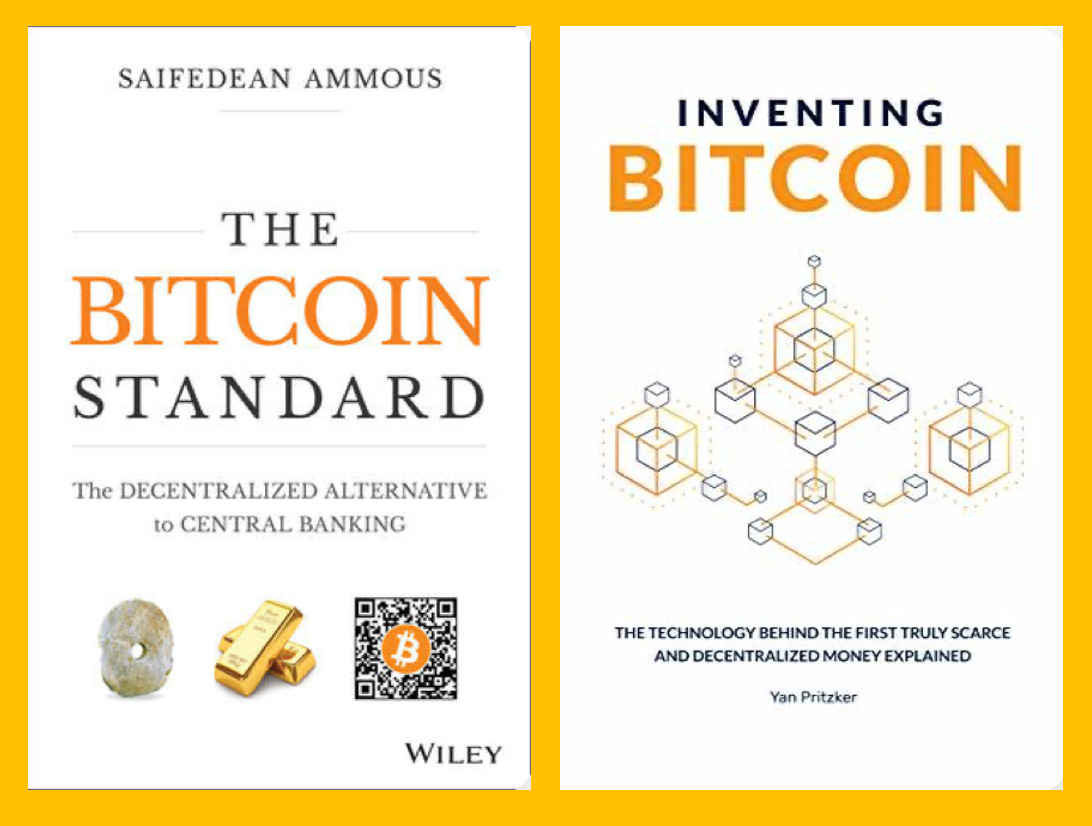
The first revelation came after reading “The Bitcoin Standard” by Saifedean Ammous. Surprisingly, most of this book doesn’t directly concern Bitcoin. Its topic is money. What it really is. What technologies have served as money throughout history. Why some technologies are suitable for this function and others are not. What is hard money. And finally, the basics of the Austrian school – the nineteenth-century liberal economic theory initiated by Carl Menger and developed in the twentieth century by Ludwig von Mises, Friedrich von Hayek, or Murray Rothbard. Ammous has done something important: he effectively sowed doubt in my mind about the possibility of maintaining an existing economic system based on the teachings of Lord Keynes in the long term. The Keynesian system, based on state control of the supply and price of money and stimulating the market with printed money to increase consumption, is today the mainstream of economics. One could say that it is part of our everyday life that we no longer even notice. However, analyzing the principles of its functioning leads to the conclusion that it is nothing more than… a deliberate way of draining economic value away from citizens by the state. Primarily through money printing and inflation.
From the kingdom of money and economics, I moved to the land of technology. I picked up “Inventing Bitcoin” by Yan Pritzker because it had a reputation for being the most accessible lecture on the engineering of Bitcoin. Cryptography, P2P, Proof of Work, and blockchain. Four different technologies, together forming the pillars on which Bitcoin is built. When Satoshi Nakamoto announced the White Paper on October 31, 2008, all of these technologies had already existed for some time. The invention (or perhaps discovery?) lay in their original combination and use in one network. Although each of these technologies is a separate path that can be followed as deeply as one wishes, Pritzker’s narrative was a perfect compromise for me – a technological layman – between detail and accessibility. It allowed me to understand in a concrete way how Satoshi created the white crow – a system that is both decentralized and hyper-secure.
At this point, I was already deeply immersed. I compulsively devoured more books, articles, and podcasts. I also began to resemble a maniac who redirects every conversation to the topic of Bitcoin and seems to think of nothing else. Many inviting branches appeared in the rabbit hole. Austrian economics with its theory of money and markets, cryptography and its history, game theory, programming, property protection and human rights, energy and the energy market, ecology, trading, and technical analysis, on-chain analysis. With each step, the path seemed longer.
It’s not difficult though
I do not mean to say that Bitcoin cannot be used without understanding Austrian economics, the technical details of Bitcoin, or other numerous related issues. On the contrary, you can and I encourage you to try. It’s easy; wallets are apps that can be easily downloaded and installed on any smartphone, and using them is easy and intuitive. After all, millions of people use government money and the traditional financial system, although very few actually understand the principles of their operation. Accepting and making payment in Bitcoin is therefore trivially easy today.
However, if I claim that it is worth understanding Bitcoin thoroughly, it is because with each day of delving into the rabbit hole, I became more and more convinced that I was dealing with something exceptional, mathematically perfect, and beautiful. That Bitcoin represents an epochal discovery. One that has the potential to change the world and, at the same time, fix many of the ills that surround us.
(Originally published in Polish, iMagazine, issue 1/2023, English version prepared with the assistance of ChatGPT by openai.com)
Selected books for beginners:
-
The Bitcoin Standard, Saifedean Ammous
-
Inventing Bitcoin: The Technology Behind The First Truly Scarce and Decentralized Money Explained, Yan Pritzker
-
Bitcoin clarity, Kiara Bickers
-
The Internet of Money, Parts 1-3, Andreas Antonopoulos
-
Bitcoin: Hard Money You Can’t F*ck With, Jason A. Williams