
Bitcoin differs from other cryptocurrencies and bank-issued fiat currencies in that it is resistant to manipulation. It makes Bitcoin a unique system in the history of money.
The Truth on the Bitcoin Network
We have established that Bitcoin is a ledger recorded on a blockchain stored on tens of thousands of computers around the world. It is clear that the ledger’s records on all independent nodes should be the same, and in the event of discrepancies, there should be a simple way to determine which version of the ledger is true. But how can this be done?
Satoshi discovered a solution. He introduced the principle that the version of the ledger containing the longer sequence of blocks is the true one. This solution is brilliant in its simplicity. In every case, the decision on which published transactions have been added to the ledger is actually determined by the majority of the network’s computational power. That is, by those who collectively make the greatest investment in protecting the network. Therefore, if two blocks are confirmed by different miners at the same time, two independent branches of the chain will momentarily appear. In such a situation, the block to which a greater number of subsequent blocks are eventually attached contains the truth about the state of the ledger. The blocks that have lost this competition are treated by the network as non-existent, and as a result, the transactions recorded in them are also non-existent. Bitcoins recorded in such blocks have the same status as bitcoins that were never spent by their owners.
Because there may be a period of uncertainty as to which block will emerge victorious, the exact moment of making a bitcoin payment may not be easy to determine before the competition is resolved. This is because it is about the moment when it is already known that no other block is competing with the block in which our transaction was recorded. Usually, this will be the moment of the first confirmation of that block by a miner, although at that point, it cannot yet be certain that there is no competing block that will ultimately win the competition. However, it can be calculated that a transaction that has been confirmed by six subsequent blocks is already physically irreversible due to the enormous computational power that would be required to create a branch that “outperforms” the main chain. Therefore, most wallets treat such a transaction as finally completed.
Time in the Bitcoin network
The blocks that win the competition contain the final and irreversible truth about the transactions made. This applies not only to who paid whom how much, but also to the chronology of subsequent payments. The time and order of transactions are of course of great importance in the monetary system. We can spend funds only when we possess them. Therefore, the system must determine the order of transactions to avoid the possibility of spending funds before they are obtained or after they have been spent.
The confirmation of historical blocks is a source of knowledge about the balance of all accounts at a given point in time. That is why the blockchain can be called a “timechain”. This is also how Satoshi Nakamoto himself treated it, using the term “timestamp server”. The fashionable word “blockchain” does not really reflect the most important aspect of the order ensured by the chain, which is the autonomy of its chronology. Moreover, this word does not appear at all in the Bitcoin White Paper.
The idea of Bitcoin as a timekeeper finds expression in available devices like the Blockclock, which in real-time displays the current block number, just as ordinary clocks show the hour and minute. The block number is also called the block height.
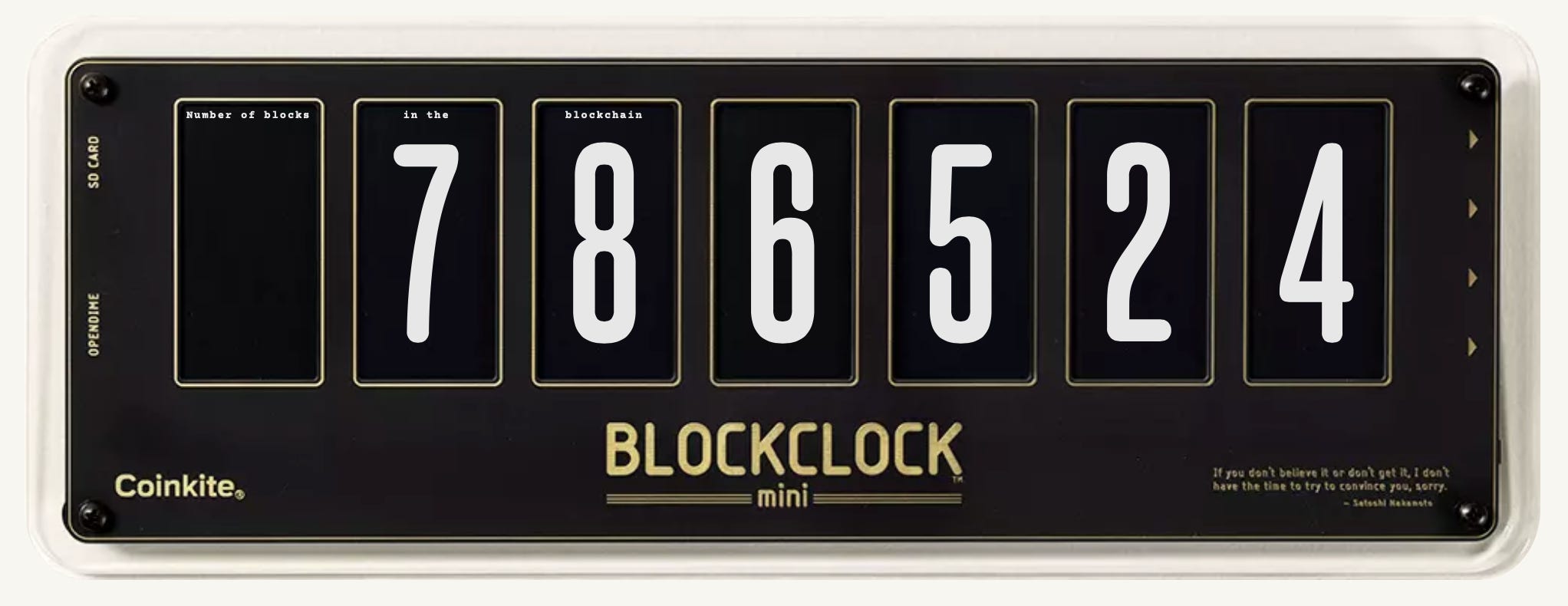
Fig. 1. Blockclock Mini device by Coinkite
There are also other visualisations of this idea, such as the popular Timechain Calendar, which shows all key network parameters in real-time.
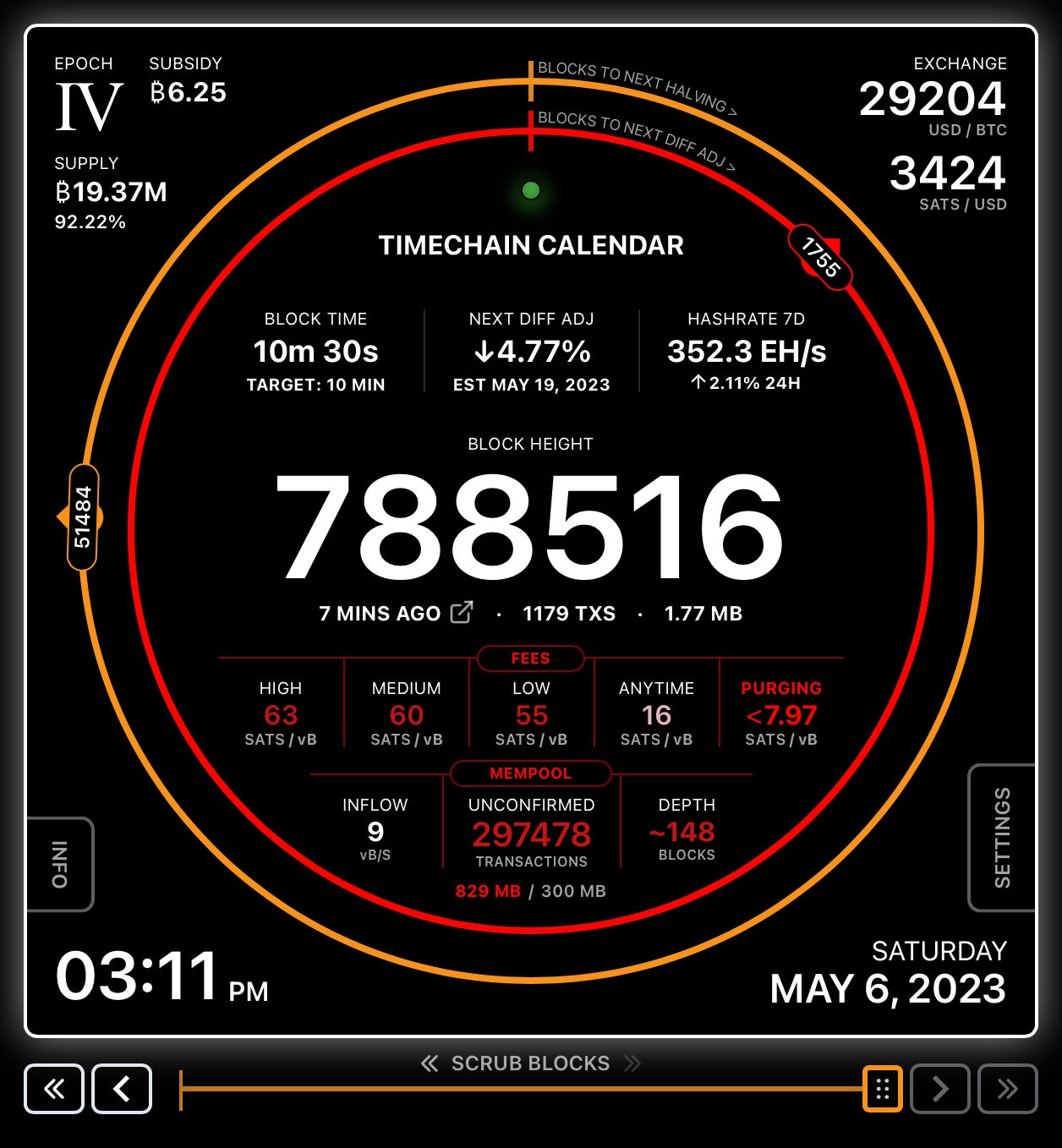
Fig. 2. Timechain Calendar.
Creating a decentralised timestamp server was a breakthrough in the history of computer science. Previously, maintaining the chronology of events in a ledger required a central server and external system assistance. An example of this is the banking system, where banks ensure that the order of transactions in the ledger corresponds to their actual chronology. Eliminating banks we must immediately ask the question: who will maintain the chronology? This problem is particularly difficult to solve in a decentralised peer-to-peer network, where each node has the same privileges as all other nodes. How can we resolve disagreements about the order of transactions in such a network without having to trust anyone?
Contrary to what one may think, it is not possible to refer to any objective measure of time outside of the network. Choosing any external source of time measurement would have to be based on trust in the entity making the measurement, whoever that entity may be. We would also have no guarantee that this external timekeeper will not disappear in the future. Therefore, the mechanism determining the chronology had to be located within the network, be independent of its users, and any external timekeepers.
Creating such a mechanism was a task that many people tried to solve. Satoshi was the first to succeed. Bitcoin has its own time measurement system with a frequency based on the frequency of mined blocks. It is independent of the time we measure with clocks. Its only source is the Proof-of-Work protocol and the associated probabilistic mechanism for finding blocks. The system also has a built-in corrective mechanism in the form of adjusting the difficulty of mining a block. Thanks to this, the probability of finding a block is adjusted every 2016 blocks to the expected frequency of one block every 10 minutes.
The Bitcoin clock ticks with the appearance of each block. It does not matter that the time intervals between blocks are not perfectly equal. The most important thing is that the chronology of transactions leaves no doubts, and its determination does not require relying on any external time measurement source. This is an impressive engineering achievement and another revolutionary aspect of Bitcoin.
Beacon of truth?
The immutability of the ledger and its absolute chronology sometimes lead people to say that Bitcoin is the truth or that it is time itself. I believe that such assertions are to some extent justified. We have very few sources of information around us that give us complete certainty of their truthfulness, if they exist at all.
This problem is particularly evident in the world of the Internet, where all sources should, in principle, be treated with skepticism. In this environment, Bitcoin appears as a completely unique source because it guarantees the truthfulness of data without relying on external authorities and without the need to trust anyone. If I had to point out any other source of information that offers even similar guarantees of data truthfulness, I would have a serious problem with that.
(Originally published in Polish, iMagazine issue 5/2023. The title and subtitle have been changed. English version prepared with the assistance of ChatGPT-4 by openai.com)