Our article of 23 October on the first weeks of the deposit return scheme addressed, among other things, public awareness, the operation of reverse vending machines and ideas used in commerce to “circumvent” the scheme.
After one month of operation, the first packaging bearing the scheme marking can be found in shops. According to government information, around 100,000 bottles with the deposit marking, placed on the market by 12 producers, are currently in circulation, and 45,000 shops have signed agreements with scheme operators[1].
The Zwrotomocni campaign
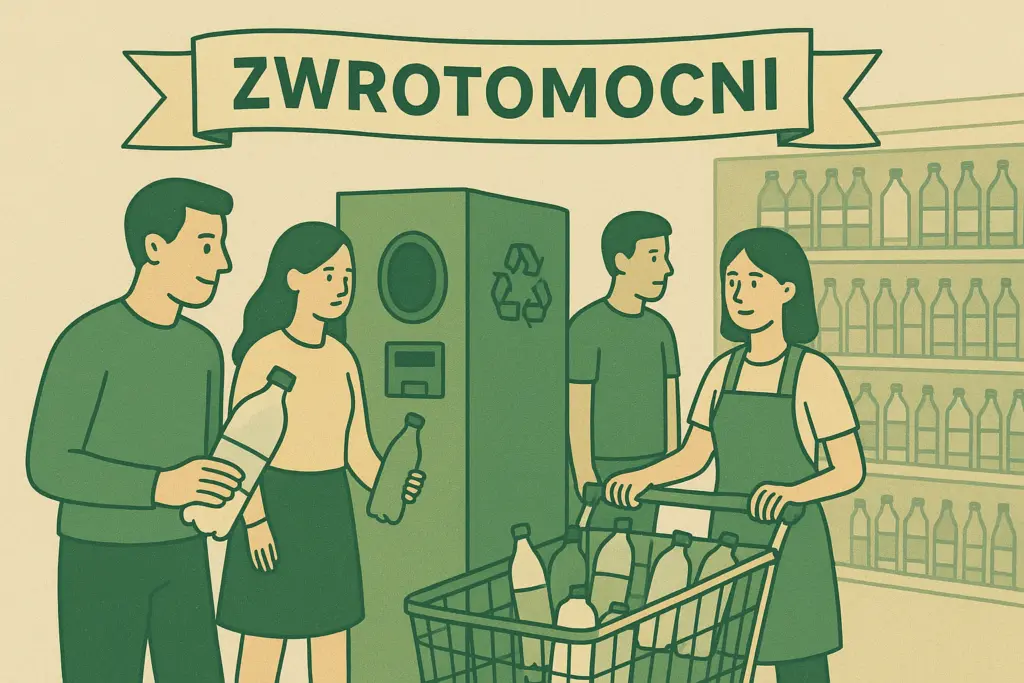
Raising public awareness of the applicable rules is undoubtedly crucial to the scheme’s effective operation. The “Zwrotomocni” campaign is currently running. Its protagonists are actors Olga Bołądź, Piotr Polak and Sebastian Stankiewicz, who play returned beverage containers. The campaign aims to inform the public about the scheme’s benefits, explain packaging return rules and deepen public awareness. Other activities promoting information and the very idea of the scheme are also visible.
Reverse vending machines
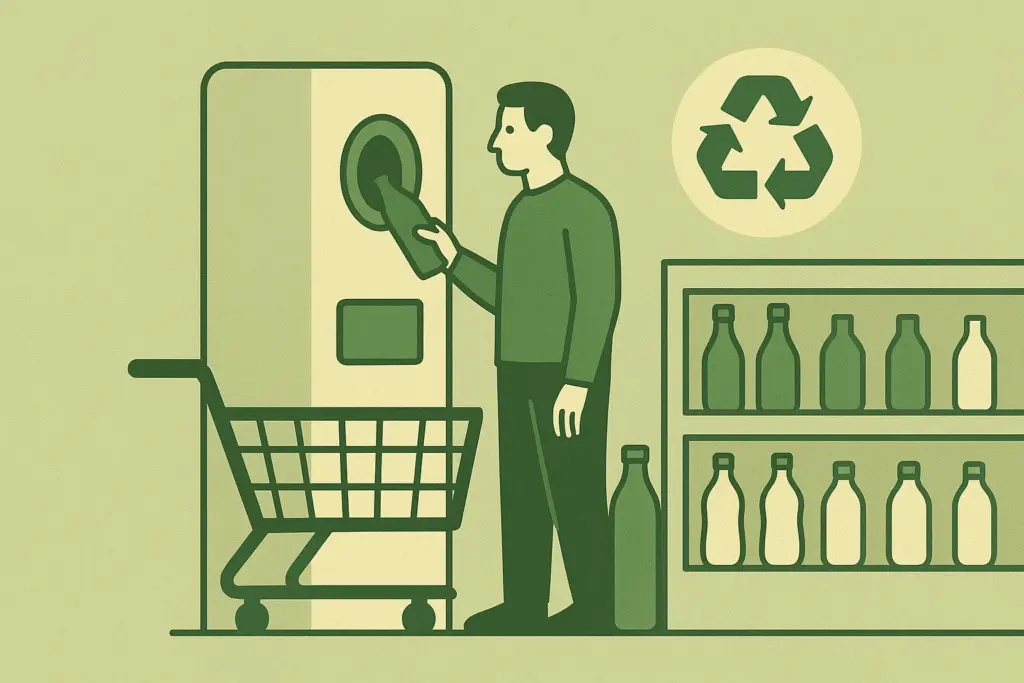
Over time, more shops are installing reverse vending machines, which allow packaging covered by the scheme to be returned, and organising promotional campaigns. For example, despite their small size potentially allowing limited participation in the scheme, Żabka stores are already introducing their first machines at selected locations. To encourage returns, they also offer 50 “żapps” loyalty points for every PET bottle or can, whether or not it is already covered by the scheme. If it bears the deposit marking, the deposit paid is refunded as well.
How are the machines functioning after a month? Bottle volumes have not yet reached their intended level, so their success cannot be assessed conclusively. For small shops, buying a machine may prove difficult and relatively unprofitable, given purchase prices starting at PLN 25,000[2].
Using the scheme
Research into public awareness found that 48% of respondents knew about the scheme, 16% were very familiar with it, and just 6% did not know its rules. Research by UCE Research and Shopfully[3] found that 12.1% of adult consumers had used it. This result reflected the relatively small number of returnable containers available. Among the 85.2% of consumers who had not yet used the scheme, the main reason was a lack of opportunity (23.7%); 12.4% said they were currently collecting bottles and intended to return them, while another 17.4% did not plan to participate. Awareness and use are expected to rise steadily. An important factor is the currently limited quantity of packaging on the market, which will increase over time. As the number of packages grows, so will the motivation to participate and, consequently, awareness and participation.
Additional producer fees
By the end of 2025, producers that have joined the scheme should stop placing beverages in packaging without the deposit marking on the market. This does not mean those products cannot be sold; rather, they should no longer be introduced into circulation. Otherwise, producers face additional costs in the form of a product fee at the triple penalty rate. In 2026, businesses placing packaged products on the market that join the scheme but fail to achieve the required recovery targets will pay PLN 1 per kilogram, while producers that do not join will pay PLN 3 per kilogram. One kilogram corresponds to approximately 40–50 PET bottles, giving a fee per bottle of around PLN 0.06 for businesses outside the scheme and PLN 0.02 for participants[4].
Conclusion
Available research indicates a noticeable increase in public awareness after the scheme’s initial operating period. Discussion of the new rules is becoming more common, while shops and consumers are gradually adjusting. The real test of the scheme’s efficiency will nevertheless come in 2026, when the end of the transitional period should significantly increase the number of deposit-bearing packages and consumers will have to pay deposits when purchasing products in packaging covered by the scheme.
[1] Government report on the scheme’s first month (in Polish).
[2] Reverse vending machines in the deposit return scheme (in Polish).
[3] The scheme works only in theory: confused retail customers (in Polish).